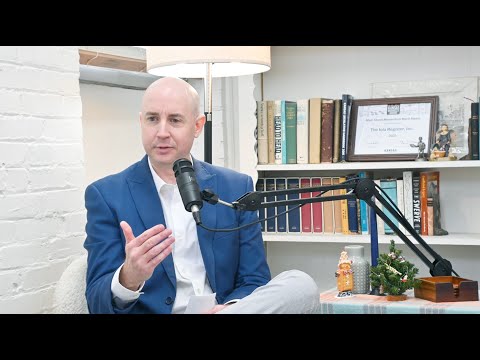
Dr. Erik Unruh, an Iola family physician, offered an analysis of Medicare Advantage during last Thursday’s meeting of the Allen County Blue Dot Club. About 35 were present for the group’s monthly meeting at the Dr. John Silas Bass North Community Center.
Unruh, who works at the Community Health Center of Southeast Kansas in Iola, began his presentation with a few disclaimers. First, his opinions were his own. Second, he had no intentions of offering individual advice with regards to insurance. And third: health insurance is incredibly complicated.
Unruh began with an overview of traditional Medicare, a government program signed into law by President Lyndon Johnson in 1965 as part of the War on Poverty. The original legislation, the Social Security Amendments of 1965, created both Medicare, designed to provide healthcare for the elderly, and Medicaid, a health insurance program for people with limited income.
Individuals over 65 are able to enroll in Medicare, and their healthcare is managed through the federal government. Parts A & B of Medicare cover hospital and medical insurance, while Part D, which covers prescription drugs, is optional. Traditional Medicare usually covers around 80% of outpatient costs.
Medicare mostly functions as a fee-for-service program, where healthcare providers are reimbursed by the government for services they provide. In fact, Medicare reimbursement rates are often industry benchmarks for how much services and medicines cost. Those payment rates are set by the Centers for Medicare & Medicaid Services.
Medicare Advantage, explained Unruh, is a different healthcare model. Known as Medicare Part C, Medicare Advantage is managed by private health insurance companies. Instead of operating on a traditional fee-for-service model, these companies receive a fixed payment from the Centers for Medicare & Medicaid Services for every patient enrolled.
According to Unruh, there’s the rub. Rather than providing the highest level of care, said Unruh, the fixed payment model incentivizes companies to restrict access, delay care and increase out-of-pocket costs.
Unruh mentioned prior authorization as a prime example. Prior authorization is when a patient’s health insurance must approve a procedure or service before agreeing to cover it.
According to a report by the KFF (formerly the Kaiser Family Foundation), virtually all enrollees in Medicare Advantage must obtain prior authorization for services. In fact, the KFF reports that 99% of people with Medical Advantage plans are required to get prior authorization for higher cost services like chemotherapy and stays in a hospital or skilled nursing care facilities.
Medicare Advantage insurers made nearly 50 million prior authorization requests in 2023 alone, compared to 400,000 in traditional Medicare. That year, insurers denied about 6% of all prior authorization requests.
Yet about 82% of Medicare Advantage denials are eventually overturned, leading some healthcare analysts to doubt the insurers’ medical reasoning. Less than one-third of traditional Medicare appeals are overturned.
There are legitimate reasons for prior authorization, admitted Unruh, but when the process becomes so cumbersome for both the patient and the doctor, “at some point people just give up,” said Unruh, and go without care. And even when a denial is overturned, Unruh noted, the process takes time and results in delayed care.
Paperwork isn’t why a lot of family doctors go into medicine, Unruh observed. “As doctors, we tend to recommend something because we think it will work. But the more time we spend fighting a time-consuming bureaucracy – it makes us start to question why we’re doing what we’re doing. It causes moral injury. It’s a major cause of burnout as well. We’re often caught between what we feel like is best for the patient and what we think we can get approved based on your insurance.”
MEDICARE ADVANTAGE has exploded in recent years, with enrollment nearly tripling since 2007. It now covers over half of Medicare enrollees. Unruh admitted it’s an attractive option for many. With lower monthly premiums and the option to roll Medicare Parts A, B and D in one plan with a single price tag, it’s easy to see why many seniors choose Advantage plans.
When an audience member told Unruh of her positive experiences with Medicare Advantage, Unruh acknowledged many seniors feel the same. “It has to work for people, otherwise there’s no way it would be as popular as it is,” he said.
But Unruh sees the rise of Medicare Advantage as a societal shift towards privatizing all healthcare. There are consequences to doing so, he noted. First of all, it’s often more expensive.